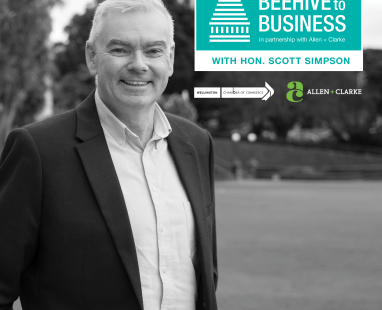
Good morning, everybody. Sorry, I've been travelling a lot. I don't know where I am.
Can I recognise Your Excellency's Ambassador of Italy, of Argentina and also of Korea. These are my three favourite countries. Christiane came to Rotorua with the EU Ambassador earlier this year, where we celebrated one year anniversary of the early entry into force of the EU New Zealand FTA.
It's been a phenomenal success. In that period of time, we have seen tariff rates put on us by the US at 10% and then 15% with predictions that at 10% New Zealand would lose $900 million because of tariffs. At 15%, it goes up another $300 or $400 million.
In that very same period, and I'll talk about the US in a moment, we haven't lost that much. But in that very same period of time, our exports to the European Union have gone up by $2 billion, which tells me two things. Europeans like high quality safe food, and it is a wonderful relationship and a very high quality deal.
And so it was a great celebration in Rotorua. When I was Trade Minister last time, I never got to visit Korea, even though the FTA had entered into force. And I was forever being asked by Korean friends and diplomats, have I been to Korea? And the answer was always no, I fixed it.
I've been there twice this year. Your government hosted APEC and did a fantastic job. I've been to a few APECs over the years.
And this was one of the toughest ones, because of course, as well as all the uncertainty around trade everywhere around the world, there were a number of very significant bilaterals. Of course, the President of China and the President of the US met formally, probably the first time, to talk about trade and reached a form of agreement that starts to give us all certainty. So thank you to your government and your new Trade Minister, who I get on very well with.
He sends me messages and we backwards and forwards every now and then about, he gives me recipes for Korean food. And in return, I promise to help him get into trade deals. So it's working pretty well.
And Argentina, you have my second favourite rugby team, sorry to the Australians here. And also some of the best beef in the world. So look, the Anxioly, thanks so much.
To the new CEO, congratulations. You are my favourite CEO. It used to be of a chamber, it used to be Auckland, but now Simon Bridges are there, so it's you.
But you have a very big responsibility. Wellington and the business community is important. It is not just Wellington business, it's the interaction with the beehive and everybody in Parliament.
And so I know you'll do a great job. And my former, well, actually, I was going to say worked for me as a minister previously, but more importantly, a former reporter from the Rotorua Daily Post works for you here, Christy. So just to recognise you, you've done much more since those days.
And so good. Ladies and gentlemen, so it's interesting, you were talking about my portfolios. I often say, you know, as Minister of Agriculture, when I go overseas, I have the easiest job in the world.
And that's because New Zealand farmers are innovative. They produce some of the world's highest quality, safest food. Consumers around the world want it.
We produce enough food in New Zealand for 400 million people to get 10% of their diet every year. Our farmers are innovative. They are leaders.
And many other countries around the world, farmers see what we do, and they want to emulate it. They want to do the same thing. It's a very easy thing to be New Zealand's Minister of Agriculture, and you can do it with pride.
Because it's so good, it's bloody hard to be New Zealand's Trade Minister, because countries around the world at the same time want to protect, they're worried about what we do. We might flood their markets and hurt domestic production. Food, and particularly dairy, is one of the least traded commodities in the world, but the most heavily protected and subsidised.
And so as Trade Minister, it's very, very hard, because we are forever arguing for fairer rules and a better platform, and to level the playing field for Kiwi producers. But successive governments have made this a priority. We have a very large degree of bipartisanship in trade.
At the moment, I've worked very hard since the election to make sure that can remain. It hasn't always been, and we shouldn't take it for granted. I was the Minister who signed the TPP agreement.
I didn't negotiate it, I signed it. There were parties in Parliament, including Labour, that protested against it and voted against that agreement, and went to government, and then became free traders. But the point was, it was a high-quality deal, the CPTPP.
It is important for the wider business community and our farmers that we can largely have consensus on trade and foreign policy, to give them certainty. And in a world that is very uncertain at the moment, the best thing a New Zealand Government, our Parliament can do is find pockets of certainty around the world, so our exporters can make decisions for themselves as to risk and where they want to put their effort. The Government has an and trade policy.
We want to trade with the US, and China, and the European Union, and India, and the Middle East, and, and, and. It is not for us to tell you what you should do. It is to level the playing field, to try and give you certainty, set up rights and obligations within trade agreements, and then work with you to work out where you should put your effort.
But when governments start deciding they know best, ultimately it's when things go wrong, because it's a bit like taxes. It's not our money, it's yours. We have to be very cautious and very careful in what we do with that, how we take it and how we spend it.
But successive Governments have been very good at this. New Zealand has about 100 free trade, investment, or double tax agreements around the world, and we cover most of the major economies. When in opposition, you, Fletcher, you'll remember this, a lot of time to think in opposition, sometimes too much.
But when I had to do, had to do a trade policy two years ago, going to the election, I have done many of these, both as Minister and not as Minister. And I thought, it has to be different, one to capture the minds and the hearts of the minds, but also to be meaningful, because the New Zealand trade policy normally goes something like, we want to do trade deals and sell some more dairy, right? And there is so much more to our economy, if I look at the companies in the room, so much more to our economy. And so I thought we should judge the success of our trade policy as much on how much extra we export as the number of deals that we do.
So I'm, as with Chris Luxon, a very big believer in setting targets, ambitious ones that are hard to achieve. Because in Government, if we are not working hard to achieve the tough things, then actually it's our job, nobody else will. Certainly nobody overseas will do it for us.
So we set the ambitious target of doubling the value of exports over 10 years. And I remember getting quite a bit of criticism for it. My counterpart, who was the Minister at the time, who I get on very well with, and we talk quite a lot about trade, came out and said, well, it's crazy.
And I said, he's attacking me for being ambitious for New Zealand. I don't mind that. But the point of this was, we set that target.
And remarkably, the civil service and business and industry have rallied to the call. And everybody talks about it now. If we do this, it'll help double the value of exports over 10 years.
The horticulture industry has set ambitious targets of what they want to do, how we should change the RMA so they can meet their obligations around environmental quality, improvements, but also freeing them up to innovate, to plant more, to make more money overseas, double the value of exports within 10 years. Not the volume, some of that, but the value. We also said we want to do more trade missions than any Government ever has before in our first term of Parliament.
We announced that, we got to Government. My first meeting, I had to ask how many that was. I didn't know.
And it was a lot. It was last time we were in Government. It happened to be last time I was Trade Minister, although I only did one then.
It was Stephen Joyce did a lot of the heavy lifting. And we are on track. We've done 17 high quality trade missions so far that have ministers there, with about $2 billion worth of deals being signed during that period of time.
Some of those were going to be signed anyway. It wasn't, we show up and I don't negotiate company to company. But actually what it does is it focusses the minds, it brings people together, and it moves the decision to sign a contract forward in many countries around the world.
And as far as our exports are concerned, the primary sector for the first time has set $60 billion worth of exports. 80% of the goods we export overseas comes from the primary sector, food and fibre. And for anybody that doesn't understand the importance of the primary sector of the New Zealand economy, they fundamentally don't understand how our economy works.
But it's another and strategy. It's not just farming or forestry. I'm a big advocate of that as a minister.
It is services. It is innovation. It is high tech.
It is science. It is tourism. It's everything we can do.
We have to do it better. We have to be more efficient and more productive. And we have to find ways not to charge more for it, but to get more value for it from it for New Zealanders.
And we've just been able to announce for the first time New Zealand's exported over $100 billion. It's actually $108 billion. The growth is happening.
It is coming. And it is a result of things. Some of the things the government is doing, the focus on trade, the talk, we're out on the world stage hustling the trade ministers, trade missions.
But actually, it is the New Zealand business community in uncertain times are stepping up and looking for advantage and doing what Kiwis do best, getting out, making friends, and doing business. And it's a long term sustainable business. So thanks to all of you that work in that area.
We've done very well in trade, though. We were able to do two trade deals last year. New Zealand's fastest ever negotiated in highest quality with the UAE, which I find quite exciting.
I'll tell you a few funny little stories soon that I know you won't tell anybody because I'm being live streamed. But the point of this is it was done in just over three and a half months. When it entered into force earlier this year, you think about that from start to finish, three and a half months for a trade deal.
When it entered into force this year, 98.7% of everything we export was tariff free. And the only restriction in that market is the restriction we put upon ourselves. Go and jump on the plane, Emirates, direct to Dubai, talk to people.
They want what we produce and they are willing to pay very, very well for it. And more than that, they then want to add value to it and export it around the region as well. It's not just what they consume there.
We did a second one with the GCC, Saudi Arabia as part of that, you know, trillion dollars economy across the GCC. Some of you may actually know, you're all too young. Many years ago, we tried to do a trade deal with them and we had sheep in the desert up there, you'll remember.
Seems sheep don't like deserts. This one was a bit longer, it took six months to do. And on entry into force, about 80% of what we send them is tariff-free, going up to 99% over 10 years.
A fantastic opportunity for New Zealand exporters, a part of the world that is growing, they have a lot of money to invest, they are very interested in us. The only real restriction is the one we place upon ourselves. We've got to get on the plane, we've got to get up there because nobody will do it for us.
And then you will have seen Chris Lux in opposition set a very ambitious target for me. We're going to do a trade deal with India in our first three years of government. That may or may not have been in the speaking notes, but it doesn't matter because actually, he set a target and we're doing it.
And I've just come back from a trip to India. I had a very long trip. Actually, I asked AI on someone else's phone, I asked it, how long will I have been on aeroplanes? How many hours and how many kilometres will I have flown if I do the following trips? He just put it all in there and so on, because I was thinking that will take me a long time.
And it said 71 hours and two weeks, and about 50,000 kilometres. My poor officials, we would sleep on the plane overnight, which would be between a six and 12 hour flight, get off, go to work, get on the next one and so on. But we spent a lot of time up there in India.
I think that was my seventh visit there since the election. Our negotiators have been up there maybe 20 times since then. We are putting every effort into this that we can with the view of, you know, getting a trade deal this term, because the Prime Minister is right, if we're ambitious and we push hard, why not? Why do these things have to take a long time? The approach that I've taken to trade, having thought about it in opposition and from the Trade Minister before, it should be no different than you as a member of the business community.
You don't go and do a business deal with somebody to rip them off, someone you don't like, and then dump them to go and find someone else. You want a long term sustainable relationship, the two businesses can grow together, it's mutually beneficial, it's symbiotic. And actually, you have certainty.
And actually, the approach should be the same with governments because governments should get on. We want to do a trade deal with India and the EU, we've done in the UK, because we are like minded, there's a lot we can do together, it'll help the two economies grow, which is better for citizens. Through trade, people have certainty, they have more choice, prices come down, and they earn more.
It's as simple as that. And so the approach there has been to say, well, you know, there will be challenges, sensitivities, let's not keep arguing about it. Their Minister Piers Goyle and I agreed very early on, we will only launch the agreement if we are committed to doing it in a reasonable timeframe.
And where our negotiators come up against a roadblock, he and I will step in and make a decision so they can move on. And we had to do that quite a lot in the early days. Guess what? Officials hate ministers interfering, they don't come back to us very much anymore.
They are now incentivised to make decisions and to get on with it. And I was talking, I talked to them yesterday and today, we have now set up a process where the negotiators are talking a lot. We are starting to get close to the end game, remarkably, because we only launched on the 21st of March of this year.
So we're not going to break another record. But actually, for, you know, if we can do that during this term of Parliament, having only just started earlier this year, that will be significant for New Zealand. It will be as significant in time as our trade agreement with China and our trade agreement with the European Union and our relationship with the UK.
I have no doubt about that at all. But he and I have agreed that as the negotiators are going through things heavily, he and I are going to talk daily to check in on them and make decisions if we have to, which is our way of sending a message to the negotiators, you know, you better go on with your work because we can still bugger it up. And so the point of that is we get on very well, we want to do a deal together.
The Indian government has been saying for the first time we want to do a trade deal with New Zealand. In fact, when the US put up to 50% tariffs on them or whatever it was, Prime Minister Modi came out and he said, as a result of that, he said three things. Number one, Indians buy from India.
Number two, we are speeding up our negotiation with the European Union, Norway and New Zealand. And he said, number three, we're going to transform our economy by investing and growing and so on. So a little country of 5 million people compared to 1.4 billion people with a growing middle class who have the ability to buy everything we produce 10 times over, should we just send it to them, is saying they want to do a trade deal with New Zealand.
So my job is to get on a plane, to get out there and to find that opportunity, open the door so you can go through it and help us double the value of exports in 10 years. Do you know why that's so important? If we can do that, and New Zealand will, then the quality of life for every New Zealander goes up. If you have a company that exports, you employ more people and you pay them more because you're more productive than a company that doesn't.
If you have a company that exports, you generally employ more women and you pay them more for whatever reason. You could analyse it, don't have to. It works, just keep doing it.
And so New Zealand is an export economy, but it has changed over the years. It is not just about butter or dairy anymore. That's important, but it is not the most important part of our economy.
It's all the other things we do added together. The final thing, if I may, and then I'll stop because I'm sure we've got time for questions and comments. The way that we grow the New Zealand economy is to back Kiwis and make it more productive.
And in your businesses, if you have things you've always done, rules, processes, and so on, and you've never looked at them and changed them, then you get out of date very quickly. Often you'll pay a consultant to come and have a look for you and change it. Governments are no different at all.
In the agriculture space, I have two jobs, back farmers so they feel happy about what they do, and they can produce more, so it can sell overseas, but to reduce their costs. Governments often don't have any effect on what farmers can earn overseas other than the trade deals. They have to go and negotiate through their exporters, you have world market prices and so on.
We can't control a lot of what happens in America or elsewhere. But I have an absolute obligation to simplify rules, to make it easier for farmers to meet their obligations, and to get costs down. Because if I sit here with my officials in an office in Wellington with no windows, never going to a farm, dreaming up ways to improve the environment, all I'll do is add cost and red tape, and it won't help anybody more and more productive.
In fact, if it costs too much to produce in New Zealand, someone else will do it somewhere around the world. That's the reason that we've gone through and used a scientific approach to setting methane targets, so farmers do what they have to, because we are committed to net zero by 2050. That's our commitment in the Paris Agreement.
We are committed to it, no question. We're not having a debate with New Zealand about whether we should, whether it is climate change, whether we're staying in Paris. The debate is how we achieve that without putting costs upon you and putting people out of business.
Because if I put a huge cost on farmers, not based on science, as previous governments have, because they think they will get votes, all you do is send jobs and production overseas to less carbon efficient countries. We are poorer, farms close down, the climate's worse, because the food still has to be produced. We have to be smart about this.
So you're going to hear more from Chris Bishop soon about the RMA. It is a very, very big grunty, not reform, replacement. We fundamentally have to do that, because there is nothing in our resource management system in New Zealand that is helping anybody in New Zealand, not even the environmentalists like it, by the way, right? So we shouldn't just keep tinkering with it, let's replace it and be smart.
And I don't think it's sexy and a big vote winner, but it has the opportunity to transform the economy over time, make it easier for New Zealand to do what they want. Because we live in a country that says, you can't do anything unless we give you permission. I came to Parliament saying, you should be able to do whatever you like, within reason.
And there are certain things you'll need a lot more permission. But over and above that, if it's your house, and you want the door to be a funny colour, and your neighbours don't like it, that's your business, not mine. And I know that we don't really look at door colours, but we're not far away from that, in some cases, right? So the chunky stuff we have to do is underway, and it's coming.
It may not be sexy and interesting. But I had a discussion last night with some people about house prices, and I said, it's really straightforward. We do want house prices to go up in New Zealand, right, slowly, not like this, predictably, so that people can plan, can build, you know, banks will lend, and so on.
But for my children, your children, first home buyers, I do want them to get onto the property ladder. And we need to find ways to make it more affordable and help them. And crashing house prices, as the last government did in the end of trying to control them, doesn't achieve that.
We have to find ways to do that, right? But anyway, the debate was, there's somebody building two and a half bedroom affordable houses in Rotorua, quite lovely ones, $500,000 they'll sell them for. And the other person at the table said, but in Tauranga, that'll be $850,000, you know, it's not affordable. And I said, well, you're right.
But with the interest rate going from about 8%, some people are fixing it to you can fix now for maybe about 4%. There's a $30,000, $25,000, $30,000 saving in interest alone for that young family. That is significant.
That is important. That's why we have been so focused, Nicola Willis has, on being careful with spending to get inflation down, to get interest rates down. People can afford their mortgages and now can afford to do a little bit more.
But secondly, I said the RMA is holding it back. The land, the reason it's more expensive is Tauranga, sure more people want to go there, we're not building enough houses, it is too expensive, too hard. So we're going to fix the RMA, fix the building blocks.
And what you get in return is the ability to do more of what you want yourself without government interference, more of your own money to spend, and actually a growing economy where the world sees us, we're doing very, very well. And our kids have, you know, all the opportunity in the world, they should go overseas and have a look around. And they should then come back again.
Well, thanks so much. I'll stop now because I was going to talk about America, I reckon I'll get a question on that. But thanks for what you do.
And please tell Simon Bridges I like you more than him. Thank you, Minister. And I've already texted and told him that.
And it's live stream. So now we're going to open the floor for questions, please. This is an incredible opportunity.
So please, who would like to start? And to our incredible guests online, please. All right, back to the bacon. Thank you so much.
Well, he said, tell us about he said, Trump campaigned on the tariff agenda. He said he was going to shake things up. He's done it.
New Zealand, he put a 10% on because everybody was 10% or higher. There was nobody else in the world that was below that. You got to feel a little bit for our Australian friends.
They had a trade agreement, and they got 10%. We didn't, we got 10%. Jump forward.
We then had an extra 5%, 50% put on us for one reason only. We had a very modest trade surplus against the US, we sold them more goods than we bought for them. And when I met with my counterpart, Jameson Greer, I've met with him many times now around the world.
I went up to Washington, and we've had calls and so on. He sort of said, if you had bought $1 more for us than you sold us, you'd be at 10%. Because everybody that had a trade surplus was a 15% or more.
Some of them many more. Switzerland got hit with 39%. So our exporters have adjusted very well to that.
We're very nimble, they're flexible. In many cases, there's growing evidence that that 10% was passed on. In either case, in our beef trade, America doesn't produce enough beef, they have to buy it from the world.
The reason they buy ours is it is lean, and it is tasty, and they grind it and mix it with their hamburgers.
So that was being passed on. But what is, you know, of growing greater concern than the tariff rates, which are harmful, they're not warranted, we don't support them, is the uncertainty and the changing nature of what's happening. There was an example I read in a newspaper, it may or may not be true, of a ship loaded up with goods that were coming from the EU to America when the first announcement was made.
And you won't remember it now, but it kept changing. And the goods on that ship, the tariff rate changed four or five times between when it left and when it arrived. So if you are an exporter from New Zealand or the European Union, how can you plan for what you're going to charge, what the cost will be, whether you'll make money or not, if the tariff rate keeps changing? And so our job has been to try and create certainty everywhere else in the world, but as well as in our relationship with the US.
It is a very important relationship and we still sell them a lot. It was our number two goods market, our number one beef market, I think it was our number one wine market. We have a lot of wood products that go up into there.
So we've been working through trying to seek that certainty from them. The very interesting news, and I cautiously welcomed this, was when the President dropped the tariff rate back to MFN or zero. Most favoured nation status means in some cases you have a very low tariff rate, or zero if there wasn't one, or beef, or turkey, or pork, and a number of other hot products and so on.
That's almost 30% of our exports. So actually, we have gone from 10% to 15%, and for 30% of our exports, some of our most important ones, back to the equivalent of zero or MFN. But the reason I cautiously welcomed it is what is taken away with the swiper for the can and pen can be put back again and there are still exporters that are facing tariffs.
So we'll keep making the case that it's a very balanced relationship. We have a modest surplus against them now. There are times when they have a very large surplus against us.
We are about to buy some helicopters from them. We in New Zealand have ordered eight aeroplanes from them. As soon as they can deliver them, it'll swing in the other direction.
And the biggest ask I have, apart from get rid of the tariff rates, but President Trump campaigned on them, that's not going to happen, is we need predictability. If we go back to a deficit, you have a surplus against us, how do we go back to 10%? And the answer is they don't know yet. So as uncertain as it will remain, people are still selling to the US market.
We are being treated the same as everybody else. And we continue to look for opportunities elsewhere, from China to the European Union, to the Middle East, to India, to all of the other nations we trade with and we're supporting New Zealand exporters along the way. Thank you.
Question down the back and then we'll come to you. Thanks. Thanks, David.
I'm Minister Peter Fenty, the Narrative Project. First of all, can I commend your work on India? I think it's a hugely exciting initiative. I think it's very exciting.
So on moving up to China recently, what was the sort of, just the sentiment about it, given the uncertainty in the whole US? So I've been to China quite a lot too over the years as Minister and a few times for holidays. I think that was my third visit to China since the election. I didn't get to go with the PM when he did the trade mission this year.
He had two ministers with him and I wanted to stay back and do a bit of work on the pharma mission stuff rather than being overseas. I'm very positive and optimistic about the Chinese market. It's not all backed up.
It's a bit of feeling and sentiment. The economy has been sluggish and slower. And I remember when I went up last year, the questions on both sides, New Zealand media was, well, the Chinese economy is not doing really, really well.
They're not consuming, it's a bit sluggish. What do you think that means? And I said, well, I'll answer that in a moment. If I said to you, not far from New Zealand, there's this country and the economy is three times the size of New Zealand or twice the size of Switzerland and you can sell anything you want in there.
Would you wanna do that? He said, absolutely. I said, what about next year if there was another one the same? Because the Chinese economy is growing 5% and the growth in their economy is equivalent to two or three times our economy. So we shouldn't get too pessimistic because it's not growing by what it used to.
There's huge opportunity for us there. They have a growing middle class. The way they consume food and beverage is changing.
They have many people now who will have apartments that don't have kitchens in them. They want ready to eat, ready to heat, ready to cook. It's not takeaways like in New Zealand.
They get food delivered now, which is restaurant quality. There's huge opportunity for us up there. The market is not doing what it used to do, the economy, I mean.
But for New Zealand, we don't need it to be doing well for everybody, just for us. And New Zealand companies have done extremely well there. Am I looking as far as the trade tensions between the two? We've always said we think they should talk and work it out.
They're starting to. Does either side actually want a really big trade war? No. Does that mean that they're gonna go back to what we would view as being normal? No, I don't think so.
But along the way as they do those sorts of things, Chinese consumers have to keep consuming. And so to the degree that we pay attention to that, we should and you should make a decision for your company and others should based upon your perception of risk. But there's still huge opportunity there.
One of the things I've done on the last trip we went up there was asked quite a few questions. And I'll have another trip early next year at some stage. I want to go and have a look at some of the tier two and tier three cities.
You know, we're in Shanghai, we're in these areas. I want to have a look at them. I don't think you have to go and have a bricks and mortar presence there in a tier three city because everything is done online to influence and so on.
Now, I want to go and have a look at it, right? Because people say, oh, it's not worth it. But these tier three cities are like three or four million people or more, right? It's the size of our economy, you know? And we're talking about what town to go in. So if we're going to have a look at that and think, where should we go over the next three or four or five years? In trade, where should we go? Where will we need to be 10 years from now? Africa, no doubt about that.
You know, we're looking at one or two countries to see if we can start negotiating and talking as a foothold. But I want to have a look at where we should be going in China as well as what we're doing now because then, well, it's simple. They deserve to enjoy the headache your beer often gives me.
LAUGHTER Minister, what's your reaction to Pontera selling off those consumer brands? Because we've been told for years and years and years we have to add value to these basic commodities, the milk products, the logs and all those sort of things. And that seems to be a move in the other direction. Yeah, well, look, I've been very cautious because I don't own the company.
The farmers do, and they will make the decision that they think is in their best interest. And we've got to be very careful. Politicians jumping in and saying we know what's best when it comes to a commercial decision.
I have a view, right, but as a politician, I'm a bit more cautious around that. Ultimately, though, if you look at the reason and the case they've made to the New Zealand farmer who's accepted it, farmers didn't do it based upon the extra payout they're going to get. They're getting a really good payout at the moment.
They've looked at the business model. They're a sophisticated businessman. They've decided what they think's best for the company.
Pontera's made the case that the return they get by growing the rest of the business is greater for the amount of effort and capital they put into that one. I would assume in selling it that they've got very tight supply agreements along the way, but their supply agreements, they believe they make more money, and so that's a decision they have for themselves. It's not a different argument around value, though, right, and going up the value chain.
Pontera continues to do that across the board. You know, they're not really just milk powder dryers anymore. The amount of value they're putting in their business, which they retain in different parts of the world, you know, in nutraceuticals, all these other things in the world is fantastic.
They, with the New Zealand Dairy Farmer, are leading the world. So I'm comfortable with the decision they made because I trust New Zealand Dairy Farmers to make a decision as to what's best for them, but that does not mean you won't have others out there saying, well, I can go and innovate, and I can add value, and I can sell and market, direct the consumer around the world. You'll see a lot of people in New Zealand doing that.
Final thing about value, right, it's not just about the primary product. So it's not that many years ago. So some of you remember, you remember, I can't remember the name, but years ago you had, you'd buy a shampoo in New Zealand that smelled like apples, and they came out of somewhere in America.
Do you remember that one? Yeah, I can't remember what it was called. Anyway, at least two of us know. No one else is nodding their heads.
Thanks, Fletcher. I can see the hair. Fletcher used to know before he got that haircut.
But anyway, the point of this is we used to make a lot of money selling apples to the US, right? A few years ago, we made more apple, more money, exporting machines designed and manufactured in New Zealand to sort and package apples to America than we did the apples. So exports to the primary sector are many things. They're not just the milk powder or the cream or the apple.
It is the innovation. And we are very, very good at that. So yes, we want to sell them apples.
Our apples are getting bigger and better. We are some of the world's most innovative, as we are with Kiwifruit, as we are with lots of things. But it's the tech that sits behind that that's going to deliver just as much for the New Zealand economy, help us diversify and help us to be more resilient to those peaks and troughs.
But I back the farmers to have made the right decision. Peter, go ahead. Do you have a question? I'm Peter Stevens, GS1.
WTO, what's its role? WTO? If we move forward to WTO, really, I suppose in some ways we've seen it being seen as being irrelevant. But at the end of the day, we've seen some significant decisions recently involving Indonesia, for example, and the EU. Yeah, yeah.
So the countries that say they're WTO are irrelevant are the ones that are holding back progress generally in it, right? And I get why that happens. It is one of the most important bits of trade architecture New Zealand will ever have. Because we're not a big player.
Yeah, we do better than we should for our relative size on the world stage in trade. We have the best negotiators in the world. And, you know, successive governments, apart from time to time, have prioritised us being offshore.
I mean, I'm at home a lot. I'm doing a lot of agriculture. But I've been on the aeroplane a lot the last two years, because that's our job.
We just have to be over there, right? And it is working again. It's working again. And Winston's doing an amazing job in the same place.
The PM has been spending, you know, the right amount of time overseas. Not as much as he wants, because we need him here. But he's been doing a really important job.
You've just got to look at the visit to Korea and, you know, the meeting he had with President Trump. Not every first meeting a Prime Minister of the world has had with President Trump has gone that well, right? So putting that aside, the WTO is important to us. Is it perfect? No.
Is it near perfect? Absolutely not. Is it broken and thrown away? Completely no is the answer. The reason it doesn't make progress is the fault of the ministers in the countries.
I tell my ambassador to go and try and get something done in Geneva. They're there all year round. They argue the same things, because nobody lets them compromise a change or find a solution.
They bring it back to us. We go to a ministerial meeting every two years and we do the same thing. And then a week later, we go away and think we haven't achieved anything.
So in the WTO ministerial meeting last year in Abu Dhabi, I was given responsibility as one of the vice chairs, which is a big responsibility for New Zealand. More to do with New Zealand, very little to do with me. I was a new minister.
And we were given the brief of the e-commerce moratorium, which says all countries in the WTO have agreed not to put tariffs on e-commerce, right? It's really important. Don't know how you'd make it work, but the moment somebody does, if others follow, it's over, it will just be a mess. There'll be, you know, everything sort of in that area becomes far too hard.
Going in there, we were told there was zero chance of achieving it. You know, virtually the only thing achieved was we rolled the moratorium on for two years. And I've just been told I'm going to be given that responsibility again.
And for a second time, be a vice chair at the WTO ministerial meeting next year in Cameroon, I think it is, in Africa. Again, because at a time when it's challenging, it is uncertainly, they're going to a small group of countries that have always stood up for the importance of trade and a rules-based system, and they're willing to get on the plane and put the effort in. And, you know, again, nothing to do with me, but for New Zealand, two WTO meetings in a row to be asked to vice chair and giving something fundamentally important speaks to the recognition that New Zealand gets around the world, as many other countries do.
So we'll be there fighting away. I'm up in Geneva end of January when some MPs will still be on holiday. And there's a smaller WTO ministerial meeting to start focussing on how we get through some of those big issues.
But for those that say it doesn't work, you know, roll your sleeves up, pitch in, find ways to make it work. Don't just sit on the outside and complain. And I don't mean the business community, I mean countries.
I'm a kia ora minister. I actually have a forestry question. Good.
I am from Gisborne, grew up in Gisborne. And as you'll be aware, Gisborne's very much dependent and reliant on the forestry industry. But talking to a lot of people that work in the industry in Gisborne, they say that there's definitely noticed a lot of the big forestry companies turning away from Gisborne, particularly after the big cyclone events and other weather events, because the land either isn't suitable for planting or for other potential investment commercial reasons.
So I guess I was just wondering if you could comment on sort of what role you think the government has in supporting recreational economies like Gisborne that are so reliant on that for jobs and livelihoods? So we have an absolute obligation to support the economy, but it's not in taxpayer cash, it's in getting the rules right. So forestry has an important role to play in Gisborne. It always has and it always will.
The company's not leaving, but they're pulling back because they're invested, right? But they're worried, and it's because the rules had been and continue, new rules, continue to be arduous on them to be able to do their business. So you've got a lot of national direction that helps councils set out what they should do, the National Environment Standards for commercial forestry. And we've consulted on changing that, it'll come through very soon.
And what we're doing is looking ways to simplify rules and make them evidence-based. So it often happens, you know, what happened in the Gisborne and Tairawhiti area was horrible to loss of local life, to infrastructure taken out, you know, lots of water and weather events, wood coming down and so on. The majority of that wood was legacy, it was based on rules previously when people had harvested, right? And so you can't go back and undo that.
So what I've done is got quite involved. And rather than just saying, do another report, rolled the sleeves up, sat down with the council and sort of nicely banged heads together. And it says, you guys are gonna, you know, previous government and we gave a lot of money to clean up and make change.
You're telling me it's not enough money. Well, if I'm gonna be the bad guy later when I say no to giving you more money, I might as well do it now. We've got to find ways to get more wood cleaned up and get rid of the legacy issues, right? Now with what you've got, and then we'll consider it.
So I set up what was called the Tairawhiti Action Group, and it was to do with forestry. And it was the council, it was forest owners, it was forest contractors, it was representatives of farming community and iwi. And they sat together, they're not paid, they're doing this voluntarily.
And they have one job, get more wood out of the system and then come up with ways to deal with this or other weather events. And what's happened is trust has been built and they are getting on, and it's starting to flow on the decisions the council has to make a bit more long term. Now, it's very hard because it's going to be expensive.
But ultimately, where we're here to say, forestry has a role to play. These are generally the rules you're guided by. If the council wants to go further, the more stringent, it must be based on evidence or you can't do it.
Because lots of things that happen in New Zealand are not based on evidence. Here's a problem, if we announce this, we'll fix it. And inevitably, you've got to do it again and again and again, and that is a cost on business.
So my experience is the vast majority of foresters around the country, and certainly in Gisborne, are responsible and want to be. They know what went wrong, they know how to fix it. The council has to sit with them and work that out or they'll never get it right.
And I've been really, really clear, if you don't do that, I will do it and none of you will like it, don't want to. They're moving in the right direction. There's a pressure point coming up though, and that's around land use change.
There'll be areas where it's forested, you can't keep forests anymore. There can be carbon credits attached to that. You know, they've come to the government and said, we need hundreds of millions of dollars.
I've said, no, you sort it out first and then we'll look at what the cost will be and how we meet it. Because I'm mindful that if I say yes, then the council may not make the best economic decision for that region if someone else is paying. And on your behalf as taxpayers, I'm not going to waste your money.
But forestry will remain in the area. Final thing, if I may, there is one bit of good news there. There was a sawmill up there that closed a while ago, screaming and yelling, government should bail it out.
An Australian company has bought it. It is working, it is profitable. They actually are about to start co-generating energy there for their own use to get costs down from any bit of fibre they can get, including slash and everything else, they'll take it.
And they think they'll produce enough to put back into the grid up there, which is great. So had the government have intervened when we were asked to, I guarantee you we'd be pouring more and more money in and it wouldn't be working out. So it doesn't mean we don't have a role to play.
Hardly ever is the checkbook the solution because it's not often the problem. Thank you. We have time for one last burning question.
There's been a number of new initiatives recently, like the CPTPP, EU Dialogue, CPTPP. CPTPP, as in Dialogue for Feed Fibershed, what are your expectations? Well, one of the things I propose is we should change the name, the Australian. So it used to just be the TPP, right? And then, I don't know, it became comprehensive and progressive when I went out of government.
Anyway, the point is here, the Australian Minister Don Farrell has become a really, really good friend, actually. We talk quite a bit about stuff and work. In fact, he was at the Australian Prime Minister's wedding and he kept sending me photographs all of the time, which suggests he didn't enjoy the speeches.
Anyway, the point here is he finds it very hard to say the CPTPP. It's not painful, but I'm glad it wasn't a long press conference. So I've just said we should, at a given point in time, let's change the name because it is greater than that now.
It's not just the Trans-Pacific. The UK has joined. We have just allowed, we're about to welcome in Costa Rica.
We've announced that Uruguay, we are starting the process, and three other countries over the next 12 months will also start the process to negotiate with us, which is the UAE, Indonesia, and the Philippines, right? If the UAE is able to come in, because they can meet the very, very high standard that is set, because you have to meet the standard, we won't weaken it or bring it down, then actually it's no longer just about Trans-Pacific, it's something else. So let's change the name. Anyway, to answer your question, I'm very optimistic.
So what you're seeing is lots of countries, large and small, coming together to want to talk and simplify the way we trade. So our dialogue with the European Union, the CPTPP and the EU dialogue, is not about the EU negotiating to join. It is about work streams where we can agree things together.
Can we agree paperless trade and make it work? So if you want to send something in either direction, you don't have to fill out a form. Some countries, you still have to send the fax there. I've got a fax, it doesn't work.
Don't know how to plug it in kind of thing, right? Those sorts of things. We're talking about sustainable trade, but things to get rules down to give certainty that don't have to be in a trade agreement. Same with the ASEAN countries.
FIT Partnership is a future investment and trade partnership. It came out of the genesis of Singapore, UAE, New Zealand and Switzerland, small to medium-sized economies that have come together. There are now 14 of them with others joining.
We had the first formal meeting in Singapore a few weeks ago. Small to medium-sized countries come together to agree rules with each other. That is not a trade agreement.
And one of the things we are working on is paperless trade as an example, procurement rules. We're also working on sustainable supply chains or the agreement like the agreement we had with Singapore where we have committed to supply things to them and them to us in times of uncertainty, right? And the reason that we're doing that is we're saying we're small to medium-sized economies. We actually wanna bring down barriers.
The way that we increase trade and make it easier for our citizens to give them certainty is to have good, clear rules. Doesn't have to be a big grumpy trade agreement. We can do it this way.
And what's unique about this, very different than the WTO, because it's an addition to the WTO. It's not to replace it, right? What we're doing is saying we come up with this initiative. If you're ready to join it as a member, you can.
But if you're not, you don't have to. Those that are ready, go along. We don't have to wait till we have absolute consensus and unanimity.
If it's not good for you, don't do it. If it's good for us, we're gonna go ahead. And I think you will see that grow.
We've also said if 75% of the members agree, others from outside of the FIT Partnership could join in as we want. It's our way as small economies, small to medium-sized economies, of coming up with the rules. Digital trade is a really good example of that, right? New Zealand has the DIPA, the Digital Economies Partnership Agreement.
Others will join. Those rules start to be infectious, and others use them rather than inventing it for themselves. And it starts to spread and it works.
And all this does is gives you, businesses, the exporters, certainty of what the rules are. You can rely upon them. Stop thinking about governments.
Get overseas, sell more. So when I told the Prime Minister we can double the value of exports over 10 years, I was telling the truth. Don't make me a liar.
Thank you so much, Minister. And I have to say, all of us in the room just have thoroughly enjoyed your energy and definitely your mahi internationally. It's incredible.
Thank you so much. Not about everyone here, but I'm brought in. Let's double the exports.
And just as a sign of appreciation, when we put together this gorgeous little We Love Local box, we know you share. Thank you so much. Really appreciate it.
How widely is this, the TV? Who's seeing it? Because it's my- If it's logged on, you can go on and re-watch it if you're ready for it. No, no, it's good, because my mum won't be watching. She thanks you at Christmas.
I think your mum is watching, actually. Thank you so much, Minister. And thank you so much to Allen and Clarke, because without your support, these forums are just not available to us.
So, thank you to our members. Thank you to those online. And please stay in network.
And definitely, if you're not a member, please stay in network. And thank you so much. We'll see you next time.
Thank you so much. Take care. Thank you.