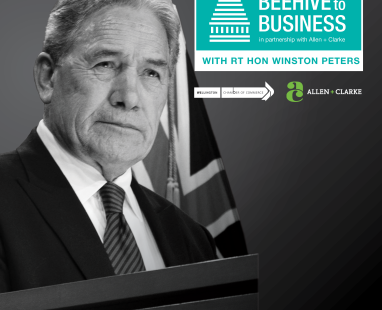
Good morning everyone and warm Pacific greetings to you all and what an amazing turnout. Thank you for making the effort to be here today. I just wanted to acknowledge very quickly at the beginning also that our very close friend from the Power of Three relationship team, Willie Laban, is receiving an honorary doctorate today at Victoria University so we're thrilled for her and congratulations to Willie from us.
But as has been the case recently we have quite a list to acknowledge and I'd like to welcome particularly the Australian High Commissioner, the Dutch Ambassador, I think Campbell Barry may be with us or joining us soon, the Mayor of Lower Hutt. And I also want to acknowledge several senior members of the Labour caucus, Jenny Anderson, Kieran McNulty, Aisha Verrill and Kushla, Taniari, Manuel, I've got to get that better pronounced, but particularly special is a friend of ours from for a long time now and that's Barbara Edmonds and Barbara, real pleasure to have you with us today, known very well through again through our Power of Three relationship. I must say I often reflect on how fortunate we were to have developed an early relationship with Barbara because it's also how I learned that the Pacific business world had invented ultra, ultra fast broadband long before we knew that because the networks are so good and you can get to know all sorts of people very, very quickly if you're there for the right reasons.
So particular pleasure of course to welcome our guest speaker this morning, the Leader of the Opposition, former Prime Minister, the Right Honourable Chris Hipkins and we're really, really pleased to have Chris here and of course have done lots with him before in the past and we're actually nearly halfway to the election next year. It's hard to believe. We're sort of a Wellington, very focused obviously on local government elections but we're nearly halfway and we're very grateful to have the Leader of the Opposition here to set out his thinking and the thinking that Labour has for the future.
I think it's a real contest of ideas when someone like Chris Hipkins is up against you. When I found out the result of the election, someone said to me, he's very dangerous in opposition and I've certainly watched him in Parliament and question time things and it is a formidable experience I think to face some of those questions. Look, it is important that also that we have the opposition at these events because we are non-partisan.
We do like to work with both sides of the house to make sure that business interests are represented and to meet them where we can and to make that work. It has been a challenging time for business and our message to every political party as you'd imagine is to commit to a long-term economic vision to grow the economy, partly because of course businesses need policy certainty to make their decisions. We certainly welcome your commitment, Chris, not to overturn every government policy but to honour the investments in infrastructure and some of those sensible bipartisan agreements that we've hoped for are possible and I think that's particularly when you look at things like overseas investment and the importance to us of having a stable strategy for the country if we wish to see real progress in infrastructure and other areas.
And of course we all want to see the economy grow. We work hard in the economy and it supports incomes and jobs when we have the right policy settings in the right direction. Today's event of course is particularly timely and you'll hear some of the Labour views from Chris as he delivers this pre-budget speech.
Just before we hand over to the Leader of the Opposition, I'd like to thank our partners Allen and Clarke. This has been an amazing journey with Allen and Clarke. We've just renewed the second year of our relationship and really, really enjoyed working together in these Beehive to Business initiatives, so thank you very much for all you do to support us.
As you are aware, Allen and Clarke are very committed to making this a great event and that means we're live streaming today along with all of the media interest that you can see in the room and of course an amazing group of people turning out here. I'd like to ask Matt from Allen and Clarke to formally introduce Chris and again give my thanks and my thanks to you all. A very warm welcome today to the Chamber.
Thank you. Tēnā koutou katoa and good morning to everyone. Thank you for joining this Beehive to Business breakfast.
It's a pleasure to welcome so many of Wellington's business leaders, innovators and community builders, especially after what can only be described as a pretty bad year or two for our business community here. If you're here and still smiling, you have achieved something pretty significant. Allen and Clarke's very pleased to partner with the Chamber of Commerce on the Beehive to Business series, providing regular opportunities for businesses to both network and also to hear directly from key decision makers.
As a consultancy that's been around the tracks in Wellington now for well over 20 years, we support both government and business to deliver on the agendas, agendas which of course don't have to be at odds with each other. Our work's involved working closely with government and the bureaucracy to design and improve how they deliver services and structure themselves to best effect, evaluate impact and return on investment and otherwise improve the health, wellbeing and economic status of New Zealanders. Working with the private sector, we've helped businesses in a similar way, helping them develop and embed their strategies, review their operating models, develop business cases and otherwise help businesses focus on what's important.
Today it's my privilege to help introduce our guest speaker, the right honourable Chris Hipkins, leader of the Labour Party. Mr. Hipkins is no stranger to the capital or to the challenges and opportunities facing businesses here and across New Zealand. Over the past six months, Mr. Hipkins and the Labour team has built out some priorities for a future Labour led government around jobs, health and homes.
Labour's recent announcements have emphasised supporting businesses to thrive, growing wages and investing in long term infrastructure, key issues for all of us here in the business community. Labour's recent statements have specifically highlighted a desire to balance economic strength with support for workers, avoiding policies that undermine sectors or increase unemployment. Here in Wellington, we know just how important those priorities are.
Our city's businesses are facing quite significant headwinds, from high commercial rates, now accounting for nearly half the city's rates burden, to the ongoing challenges of attracting talent, adapting to technological change and maintaining a vibrant city centre as working patterns evolve. To get ahead, we need policies that support innovation, infrastructure and a fairer share of the load for our business sector. Mr. Hipkins, we know that this morning you'll be talking about pre-budget issues and the debate around pay parity legislation, no doubt, which will be of great interest to this group.
However, we'd also be very eager to hear your thoughts on how Labour's evolving policy platform will address some of these challenges around support for digital transformation, workforce development, infrastructure and supporting competitiveness, if not through a speech, then maybe through some questions from the floor. And also, importantly, how might Labour work with the business community to ensure Wellington and New Zealand are open for business, resilient and ready to grow? So please join me in welcoming the leader of the Labour Party, the Right Honourable Chris Hipkins. Tēnā koutou katoa, good morning, everybody.
Thank you for joining me bright and early on this wonderful Wellington morning. I read recently one of the keys to success in life is to do the hard stuff first thing in the morning. So as we gather here for an early conversation about this year's government budget, it is a good time for us to have some hard, honest conversations about the crossroads that our country finds itself at, because I think we are at a moment that requires some honesty, a moment that demands leadership, and above all, a moment that demands hope.
So let's start with the tough stuff up front, perhaps the most contemporary issue of the day, paying for your budget at the expense of women, cutting their chance at fair pay is the opposite of all of those things that I've just mentioned. I think the reaction over the past week to the government's changes to pay equity has been swift, strong and totally justified. Women all over this country have made it very clear they felt like pay equity was something they'd fought hard for, and in some cases devoted their lives to fighting for.
It was hard fought, and we were, as a country, making progress. I want to be very clear here, as I said yesterday, I think over the last week we've seen the biggest example of a New Zealand government gaslighting half the population that we have ever seen. Telling women that cutting their pay on one hand, that they aren't cutting their pay on one hand, whilst cancelling 33 active pay equity claims with one stroke of a pen, with no due process, on the other hand, simply is dishonest.
Claiming it wasn't to pay for their budget, then admitting that their changes will see billions slashed from that very same budget, shows what their real agenda here is. I think that one of the reasons that this is resonating so strongly with New Zealanders up and down the country is because the promises that they were sold at the last election have too readily turned to dust. New Zealanders were told the economy would be stronger, but it's been slower.
They were told that the cost of living would come down, and yet prices have continued to go up. New Zealanders were told families with kids would get an extra $250 a fortnight to pay the bills, and yet only a tiny handful of families have benefited from that. They're told the government would get things moving, and yet building projects across the country have ground to a halt, and at most recent count, around 13,000 people working in the construction industry have lost their jobs.
New Zealanders were told the country would be more united, and yet it feels more divided than it ever has before. At every turn when people ask, why can't we invest in our schools, in our hospitals, and in our future, the government is giving them the same answer, there is no alternative. But let me be very clear, there is always an alternative, and there are always choices, and this government makes the wrong choices.
A $3 billion tax break for landlords, while cutting funding for things like pay equity for women. A rollback of our world-leading smoke-free laws, at the same time they gave over $200 million in tax breaks to the tobacco companies that produce the cigarettes. Borrowing $12 billion extra to pay for tax cuts, whilst cutting investment and cutting hope for future generations.
They are choosing austerity, Nicola Willis doesn't like that word, but it's absolutely true. They are choosing decline and choosing division. I think we should choose a different path, a better path and a fairer path, one that puts people at the heart of our economy, and decency back at the heart of our politics.
We've done that before, and we can do it again. There are huge challenges ahead. Challenges like the rise of artificial intelligence and the changing nature of work that's going to prompt.
The climate crisis and the energy transition that that's going to demand. An ageing population in need of care and dignity. The widening gap between rich and poor, between city and region, between young and old.
And the creeping polarisation that seeks to divide us when what we need to do most is to come together. What is the government's response now to those challenges? Deregulate here, privatise there, if it moves, sell it, if it breaks, blame somebody else. It's a government more interested in finding someone else to blame than solving the problems facing the country.
And they're trying to solve the problems of the 21st century with ideas from the 19th century. They don't have a plan for the future. They have just slogans and spreadsheets.
We do have a plan, a serious, credible, ambitious one, that's rooted in fairness, decency and community. One that believes in people, and one that backs New Zealand. Labour Party is the party that governs for all, not just the few.
So, let's start with the economy, because you can't build anything if your foundations are crumbling. The current government loves to repeat the myth that New Zealand is drowning in debt. So let's look at the facts.
Before COVID-19 arrived, our core crown debt was around 18%. After the pandemic, it peaked at 40%. That is an increase.
But it's broadly in line with the increase in government net debt that we saw during the global financial crisis, when government debt increased by 20% under the last national government. And in fact, if you include our assets, like the New Zealand superannuation fund, in fact, our net debt only sits at around 25%. One of the lowest levels of government debt in the developed world.
You wouldn't sell your house because you've got a mortgage that you can easily pay. So why would you sell your public assets and slash government spending when there isn't a crisis? But net debt isn't the full story either. Because you've also got to look at what you're buying.]
The government's net worth more than doubled over the last decade, from $81 billion in 2014 to $191 billion in 2023. We need to have a more mature conversation about government debt and assets than the one that we're having at the moment. Borrowing money to support a higher number of people getting unemployment benefits, because you've slashed government investment in areas like infrastructure and housing, simply isn't sustainable.
Now is exactly the time for government to make the investments that we need in infrastructure, in health, in our environment, so that we're creating jobs and getting New Zealand moving again. Anchor projects, funded by government, have helped us get through major economic shocks before, like the rollout of broadband during the global financial crisis. They create jobs, they stimulate the economy, and they leave a positive legacy for the future.
Yet all we've seen from this government so far is big talk about a pipeline of projects that's yet to eventuate. In fact, the opposite has happened. Last year, the government spent less on infrastructure, less on investment, than it did the year before.\
All the big talk around fixing up our infrastructure is actually resulting in less action right at the time when we need to see more. Talking about growth, and economic growth, without actually having a plan to deliver it just doesn't cut it. We need to get New Zealand back to work, just as we've done before, and that is what a Labour government will focus on.
Let's be frank, we didn't get everything right when we were in government, but I also want to put a few facts on the table. GDP per person grew by $18,000 under the last Labour government. That's higher GDP growth per person than under the Clarke or Key governments, despite the fact that we were in office for three years less than those predecessors.
Let's talk about wages. If we go back to the Bolger-Shipley government, ordinary hourly pay for New Zealanders on average grew by $3.30 over nine years. Under the Clarke government it grew by double that at $7.22, and under the Key and English governments it grew by $6.29. Under the government of myself and Jacinda Ardern it grew by $9.98. We grew the economy faster, we lifted wages faster, we created more jobs, and unemployment was lower.
So, when the government tells you that there is no alternative to cuts, don't believe it. There is. But it's not just about numbers, it's also about values.
If you're genuinely going to turn things around and provide New Zealanders with hope and opportunity for a better future, then the budget this year needs to do, at a minimum, three things. First, it will need to properly fund our front-line public services like health, education, aged care, the police, and so on. National promised New Zealanders before the last election that front-line public services would not be cut.
Yet we've seen hiring freezes in health, cuts to specialist teachers, very cruel cuts to those who rely on support for disabilities. All of these serve as examples that that simply wasn't true. The second thing the government will need to do in this year's budget is provide a credible answer for how they're going to fund all of their promises.
And that should not be at the expense of working New Zealand women. They've committed billions of dollars to infrastructure, for example, but they still haven't told the country how they're going to pay for that. The third thing they need to show is that they've got a plan to invest in our future, to rebuild our ageing schools, hospitals, state houses, and infrastructure, to create jobs, upskill our workers, and raise wages and living standards.
Because fundamentally, good economic management is about people, shifting numbers around on a page while making life harder for everyday working Kiwis is not a sign of success. How can we look our kids in the eye when we give a $3 billion tax break to landlords whilst cutting funding for food banks? How can we justify increasing returns for landlords while we cut the pay of those who clean our hospitals and who teach in our schools? We can't. We won't.
We shouldn't. Labour isn't anti-wealth, we're anti-poverty, and we're pro-opportunity for everyone. We believe in a fair tax system, and you are going to hear more from us on that very soon.
Not to punish success, but to ask those who have benefited the most to contribute their fair share to the schools that taught them, the roads that connect them, and the hospitals that care for their families. Because you cannot build a strong economy on a weak society. We want to build a country where our kids don't feel they have to leave New Zealand to build a life for themselves, where our elders can live with dignity, where no child goes hungry, where our businesses thrive, where being a nurse, a teacher, or a farmer isn't a path to burnout, but a path to pride.
We want New Zealand to be a place where our best and brightest don't just want to stay, but they can stay. Because there's opportunity here, hope here, a future here. We know that that future is going to test us.
Artificial intelligence is going to change the way we work. Climate change is going to challenge the way we live. New technologies are going to transform our industries and our workplaces.
But these aren't reasons to fear the future, they're reasons to shape the future. And that's exactly what a Labour government will do. We want to invest in green energy and the industries of tomorrow.
We have to reform our education system so that we're preparing our young people for the jobs of the future, not the jobs of the 19th century. We need to make sure that new technologies benefit everyone, not just the few. We need to build homes, not sell them off.
We need to protect our environment, not carve it up and privatise it. And we need to focus on uniting the country, not driving division. Because diversity is not a weakness, it's our greatest strength.
Whether you're Māori, Pākehā, Pasifika, Asian, or new to this land, you're all Kiwis. Whether you're a nurse in Palmerston North, a teacher in Ōtaki, a small business owner in Timaru, a cleaner in South Auckland, a builder in Rotorua, or a farmer in Wairoa, your contributions all matter. Whether you're young or old, rich or poor, gay, straight, or transgender, we see you, hear you, and we will fight for you.
Because what unites us as a country is far greater than what divides us. We're a nation of workers and dreamers, of creators and carers. We believe in fairness, in decency, and in community.
And we believe the role of government is not to sit on the sidelines, it's to step up to help and to serve. This government's making different choices, choosing a lucky few over all of the rest of us. And those choices show us, more than anything, what kind of country this government wants to build.
But the question we all have to ask ourselves is, is that the country we really want? A broken health system, children going to school hungry, people sleeping in cars, a generation, our kids, growing up believing that they'll never be able to own their own home, they won't raise their family here, they won't build their future here? Or do we want a New Zealand where everybody gets a fair go, where the dignity of work is restored, the promise of opportunity is renewed, and the bonds of community are rebuilt? We're not here to manage decline, we're here to build the future, a future where prosperity is shared and where nobody gets left behind, where we choose hope over fear, where we can say to the next generation, yes, you can dream here, you can build here, and you can stay here. We've done that before as a country, and we can do it again. We need to build a better way, and we need to do that together.
Kia kaha, kia maia, kia manawanui. Thank you. APPLAUSE Now, I'm told I've got some time for questions, so I'm happy to take some.
It's always the awkward moment where somebody decides to be the first person to ask. There you go. Thank you, Connor.
Save me. So, you talked about reducing unemployment, which is, of course, creating jobs. Yeah.
What is your vision to do that? Is it through government investment? Is it through different policy settings? How are you planning to create those jobs? I think there's a wealth of experience here in New Zealand and around the world that shows that, actually, you create jobs when government and business work together. So, it's not one or the other. It's both.
In fact, government investment stimulates private sector investment, and there's a huge wealth of evidence of where that happens. If we think about things like infrastructure investment, infrastructure investment stimulates a lot of private sector activity. So, we should be doing more of that at the moment, not less.
I mention broadband because I think broadband is a good example, and in fairness to them, it was under the last national government that it happened, the one before this one, they were investing in something that was going to benefit the whole country over time, but it had a stimulatory effect whilst that work was underway, and it was affecting every community across the country. There were people working doing that work. And so, I think those are the sorts of things we need to think about.
We don't lack for projects. There's a lot of projects that we can do. And when we think about that, we might think government-backed investment is going to support, say, the building and construction sector, but not others.
That's also not true. On farm visits that I've done around the country, a lot of farmers have mentioned the Jobs for Nature programme, which was helping with pest eradication, wilding pines eradication, and so on. Those are things that are investments in all of our collective wellbeing in the future, and the farmers loved it.
And it got people off benefits and into work that they could do. So, I think those are the sorts of things that government can look at doing more of. And it actually has a positive benefit on the government's overall finances, because we're supporting people to do jobs that are meaningful rather than supporting them to sit at home on an unemployment benefit.
So, at the moment, we're seeing quite a significant uplift in unemployment, and that puts huge financial pressure on the government, when actually we could be redirecting some of that spending into things that are going to be productive and generate those kind of co-investment conditions that we actually need as a country. Yeah. I'm Shelley Mancher from Breckenridge Country Retreat and Stay on the Wairarapa.
Could you tell us what you would do to support regional tourism? Yeah. I think we've got to look at the major events pipeline that we have as a country. It's very empty at the moment, and that doesn't just support the big cities, because actually a lot of those major events draw people to New Zealand who then travel up and down the country.
So, you know, I think Wayne Brown's got a real point about the fact that we've reduced our level of investment around attracting kind of events and those sorts of things to New Zealand. I think we need to do more in that space. Does that mean you'd support America's Cup coming back? I would, and I said this a couple of weeks ago.
It is a regret that I have that we didn't push harder to keep the America's Cup when we had the opportunity to last time. The price that they were asking got too high, and we ultimately ended up saying, no, we can't do that. When you look at the benefit we get as a country from it, I think there was probably a case for us to push harder to keep the America's Cup in New Zealand, and I regret the fact that we didn't push harder, and I regret the fact that the current government haven't pushed harder.
Events like the America's Cup matter. We've been building convention centres all over the country. Now we've got to focus on actually making sure they get used for something.
There's a big one in Auckland about to open at long last, but it's going to be a big white elephant if we don't attract events to use it. Yeah. Good morning.
Jane Bryson from Victoria University. I'm not going to ask about universities. My question is, do you have any observations on managing a coalition government, particularly where you have very junior partners who seem to wield more power than their electorate support? Absolutely.
I think MMP, and I think New Zealanders, when they voted for MMP, did so knowing that it would force political parties to work together, that majority government would be a thing of the past, and there's only been one majority government. I was part of it, but that's an aberration under MMP, and I think that was just a product of the unique time that the pandemic was. I think under MMP, we're unlikely to see a majority government again, so parties do have to work together.
But I've always taken the view, and I think all prime ministers up until this one have taken the view, that that level of influence needs to be proportionate to the way people vote. So people under MMP should still get what they vote for. And I've been quite critical of Christopher Luxon, because ACT, for example, behave like they're a 50% party, not an 8% party.
And the National Party behaves like it's an 8% party, not a 38% party. And I do think that's wrong. I think far more New Zealanders voted for National than voted for ACT, and so the fact that they're letting ACT and New Zealand First call the shots, I think, is wrong.
The major party that forms government, that ultimately has the bigger share of the public support, should be the dominant party in the government. I think the other thing that should happen under MMP, and again, I think we've seen a departure from this in the last few years, is all ministers, regardless of which party you are from, need to follow the rules for ministers. Cabinet Manual, and the most recent addition to the Cabinet Manual is one that I signed off, that applies equally to all ministers, regardless of whether you're in a coalition or you're in a support party arrangement or whatever.
All ministers need to adhere to those standards of behaviour and conduct. And I don't think you can just brush that off and say, well, they're in a different party, that's not my problem. When you're the Prime Minister, your job is to uphold the Cabinet Manual, regardless of who the ministers are.
So I don't think that what we're seeing at the moment is a fair reflection of MMP. I think MMP requires parties to work together, but it doesn't necessitate the minority, and in this case, a small minority, basically commanding the whole show. Yeah? Just in terms of running for the next election, it's been 66 years, I guess, since someone was defeated as Prime Minister and then came back as Prime Minister in the subsequent election.
It was Keith Holyoak, I think. He won four more after that, so, yeah. The last Labour Prime Minister to try that was Bill Rowland, and he lost two.
So I guess the question is how do you see yourself selling yourself to someone who didn't just lose the last election? How do you see yourself selling yourself that, hey, we're coming back and give us a second chance in 2026? Yeah. Look, I was only Prime Minister for eight months before the last election, and I don't think it was a particular... It wasn't really enough time to do things differently. You know, I said at the start of my Prime Ministership, I did want to do things differently, different person from Jacinda, different priorities, and I think you'll see that much more reflected in the next campaign than you did in the last one, because, let's be frank, particularly when you're dealing with some of the big issues, the post-pandemic backlash and all of that, it's actually very hard to reshape a government right as you head towards an election campaign, whereas I think we've used this time in opposition to reshape ourselves, and that includes some honest conversations about what we did over the six years we were in government.
You know, we had some really big challenges that we faced as a country, bigger than any recent government has faced, if you think about something like the COVID-19 pandemic, and there's a lot that you can learn from that. So, you know, frankly, I think I would be a much better Prime Minister the second go-round than the first go-round, because having had that opportunity, having had three years to reflect on that, to learn from it, and to prepare to do it differently next time, I think that would make me the best-prepared incoming Prime Minister we've seen in a generation, because no-one else has done that. So how do you sell that to the public then? Well, we're going to.
Yeah. Yeah. We've seen a lot of increased use of urgency recently, with the pay equity legislation being the most perhaps concerning for a lot of people, the way that was brushed through with our consultation.
Obviously, when Labour was in government, urgency was used and the Water Bill was probably one of the most controversial of that. Would you support changing the rules around urgency or setting a stronger criteria around the use of that? Yeah, all governments have used urgency. I've had this debate with Geoffrey Palmer, because these days Geoffrey Palmer likes to rail against the use of parliamentary urgency, when he basically wrote the rule book on how you do it in the 1980s.
But I do think urgency is overused. To put it into context around this government, though, they almost use urgency as much in the first half of their term as we did in the entirety of the last term. So I think they've passed more laws under urgency than not under urgency since the election.
And I don't think that's the way Parliament should operate. There is a change, I haven't told Kieran this yet, but I'm telling him now, that I think Labour should promote in the forthcoming review of standing orders, and one that we would implement, which is to increase the ability of government to use extended sitting hours rather than having to use urgency. So urgency often gets used just to extend the amount of time that Parliament's sitting, because the rules around that are too rigid.
I think if you said to government, you can extend the hours that Parliament is sitting, but you've got to reduce the amount of urgency that you're using, so that stuff that's going through under urgency genuinely is urgent, I think that would significantly improve the quality of lawmaking. David Seymour has made some very good points over a long period of time about rushed law being bad law, but I notice these days he thinks that any rushed law that he's doing is an exception to that rule. It isn't.
The reality is almost all law that's rushed is less than ideal, even if it's genuinely urgent. I think the other thing we need to do is build in, in terms of the quality of lawmaking, build in an automatic review mechanism for any laws that are passed under urgency. So if something's passed under urgency because it's urgent, it should still then go through a scrutiny process, even if it's post the fact, so that issues that could have been picked up with a slower process can then be incorporated further down the track.
Yeah. Hi, good morning. Chris Dunlop from Becky.
You talked about stability of policy. The last two changes of government have seen some pretty significant swings, particularly around infrastructure quite a lot. We've seen projects cancelled, change of direction, stalling.
That has led to a real loss of productivity and a loss of numbers in workforce. We've seen huge numbers of people leave the industry and go to Australia. So two questions.
One, would you commit to more stability in that sense and, you know, both sides of the House working together to get some form of stability around that? So, and the second question, is three years enough to get things done between elections and is a four-year term a better answer? The last one's the easier one. Yes, I do support a four-year term. And if there's a referendum on it at the next election, I'll be voting for a four-year term and encouraging other people to do the same.
Four years is a miserable amount of time to be in opposition. But actually, I think we would get better governance as a country if we had a four-year term. Because, but part of that would be, government would need to slow down a little bit.
So in the first year, government's pumped through often a lot of work, a lot of legislation in their first year because you need the second year to then implement it and then the third year to campaign on it. Part of the kind of the deal, I guess, of a four-year term is that you could slow down a bit in the first year. You'd still have time to do things and implement them before you're going back onto the campaign trail again.
But I think that one of the things that we do very well in New Zealand is legislate quickly and implement slowly. And I think that you could turn that around if you actually slowed down the legislative part, made better decisions more considered, so that you were better ready to implement them once you'd made the decisions. And the first question? And the first question, I can't remind me what that was.
Infrastructure. Oh, infrastructure. Yeah, so what I've said is that we're not going to just turn off the infrastructure tap by saying, look, we're putting everything on hold.
I think one of the most damaging things that the government did straight after the election was, say, take the GPS on land transport. Say, everything's on hold until we've issued a new GPS on land transport. Because effectively, that guarantees a minimum 18-month delay for pretty much everything.
And it wasn't just the big projects that got delayed. It was all the little ones that need to be done anyway. New roundabout here, new traffic lights there.
All that just went on hold for 18 months. I think about this every day, because I drive through an intersection that was supposed to have traffic lights put on it, where people literally die on a regular basis. It was supposed to have traffic lights put on it over the summer of 2023.
And the money was set aside, the planning work was being done, and then, of course, the GPS got put on hold, and it still hasn't been done. And they're now talking about the next GPS being the timeframe for that. That just means more people are going to die from that.
The truth is, I just don't think we should do that. I think if you're going to change the long-term pipeline of projects, that's fine, but you've got to continue with what's in the pipeline in the short term. And I think one of the longer-term solutions for us as a country is actually to separate the planning pipeline from the funding one.
I think one of the problems is, when government changes what they're funding, the whole planning cycle goes back to square one, whereas if we actually did the planning separately to the funding, then you'd have a menu of options already planned and ready to go, and if you change your priorities, it wouldn't matter so much, because the pipeline of work for the people doing the work would still be full. But that takes a bit longer to get to that point. One last one.
Anita Murdock, owner of Recruitment Business here in the city. And we're sort of at the coalface of seeing young people leaving the country by the week, so lots of young people are saying to us, look, we just don't see any hope for work, and so it's really just heartening to see them leaving. And also, I'm the mother of three graduates and a second-year student at Otago that I'm hoping will be a graduate at some point.
LAUGHTER You know, our kids are losing sight of opportunities here in New Zealand, and every week we're hearing from kids saying, look, if I don't have a job by the end of the month, then actually I'm going to go overseas. And I know for a fact we will struggle to get those kids back. What would you do to move quickly enough to help us to keep those kids here or to turn our country into a place they want to come back to? Yeah.
I think we've got to unleash government investment. That stimulates private sector investment as well, because that is the way you create jobs. I'll give you one really good example of where that happened in the United States.
If you go back to John F Kennedy, when he was president, he said, we're going to put a man on the moon and return them safely to the earth. The economic benefit that flowed from that was not from the mission of putting someone on the moon and bringing them back to earth, though they did succeed in doing that about a decade after. He said they were going to do it.
He was dead by then. But it was all of the other stuff that flowed from that project that we still benefit from today. A lot of the technology that was developed in order to do the space mission, we benefit from it today.
Baby infant formula was actually developed by NASA as part of their ways of feeding astronauts. There's all of this flow on benefit that comes from that. And that's where a lot of the technology we rely on today, we talk about private sector innovation and creativity, but a lot of the technology we rely on today was actually born of government investment.
The smartphones that we use, use technology developed by governments. The flat screens, the touch screens that we use were developed by governments. The internet was initially developed by government.
Government investment can create the conditions for private sector entities to thrive and create good, well-paying jobs. You take something like the internet, it was government investment that started it, that by and large now the benefit from it is going to the private sector. Government investment can stimulate the conditions in which everybody can benefit and we can create jobs.
I think we've got to be upfront about that in New Zealand. I think government doing some ambitious things, like even things like, I mentioned pest eradication before, Predator Free 2050, it's a big ambitious goal, has the potential to create jobs in the public and private sector. Dealing with our infrastructure deficit, fixing our water, building more state houses, fixing the roads, upgrading the schools and hospitals, those things can create jobs.
Moving to a more sustainable energy future, which we can accelerate, we've got options here today right now to accelerate there, that will create good jobs. Take solar panels. You know, Australia is much, much faster in its uptake of solar panels.
I'm just looking at putting them on my own house. I've literally got the quotes sitting in my email at the moment. But we could do more of that here in New Zealand and we could do it quickly.
And the thing about that is it creates jobs quickly. I think government's got to be a lot more nimble around encouraging those things. Some of it is regulatory, some of it doesn't cost government.
So if you look at solar panels, and I have been looking at this, the regulatory regime in New Zealand makes installing solar panels on a New Zealand house a lot more expensive than if you're doing it in Australia. So let's fix that problem. We could do that quickly.
So there are certainly options for government to get the economy moving to create jobs, and it is urgent. If we don't, we're going to see our kids continuing to leave. A record number of New Zealanders permanently migrated from our country last year.
We cannot let that trend continue. And that really is an articulation of the challenge. Big strategic goals and being able to be nimble to do the implementation and agile and just getting better and better as a country.
So Chris, I want to thank you so much for joining us today and your thoughts. Particularly, always impressed seeing you with questions and being able to just fire back really considered positions. I very much appreciate your time.
And also, of course, today, the time of a number of senior figures in the Labour Party that support you closely. So it's been a real pleasure. And we specialise in awkward shaped gifts.
We have those out of many things before. And now we have the We Love Local, all made in Wellington. Oh, very good.
Excellent. I'm being a bit parochial about this, even though I believe in the big strategy. But we'd love you to accept this box of Wellington goodies.
And you may even share them with me. I can see the Wellington Chocolate Company in the top. So that's perfect.
Thank you very much. Thank you. Really appreciate it.
Thank you. Yeah, that's all right. Well, that's a wrap.
Very happy. We'd love you to stay.