We’ve noticed you’re visiting from NZ. Click here to visit our NZS site.
On 19 May 2026, New Zealand’s Finance Minister Nicola Willis announced that the core public service would be reduced by approximately 8,700 roles, 14% of the workforce, by mid-2029. AI was explicitly cited as a key mechanism for absorbing that change over time.1
The ambition is right. AI genuinely can allow the public service to deliver better services to more people without a proportionate increase in costs. The technology is capable, and the direction of travel is sound. But capability and deployment are not the same thing. Global evidence is consistent: most organisations using AI are not yet seeing a return. The gap between what AI can theoretically do and what it is actually delivering sits at around 80 percentage points in administrative roles. Achieving the ambition set out in Budget 2026 requires the strategic, data, and organisational foundations to be in place before the workforce that currently carries institutional knowledge is reduced.
This paper maps the specific frictions that prevent AI capability from becoming value, draws on comparable international experience, and sets out what agencies responsible for this transformation need to get right — and in what order. The lessons apply beyond the public sector: wherever organisations are deploying AI, the same foundations determine whether the investment pays off.
|
Budget 2026 sets a target of returning the core public service to approximately 55,000 employees by mid-2029, reversing growth that saw staffing rise from 47,000 in 2017 to more than 65,000 in 2023. Finance Minister Nicola Willis announced the plan on 19 May 2026, combining agency consolidation, from 39 ministries to a reduced number, with AI as the primary mechanism for absorbing the reduction. The Government’s Chief Digital Officer will oversee investment in digital systems, with AI deployment described as a “basic expectation for all public entities.” The savings target is NZ$2.4 billion over four years. The question is not whether AI can help. It can. The question is: how does the public service overcome the frictions that block many organisations from unlocking AI’s full capability?
|
|
The current gap between what AI can theoretically do and what it is actually doing in most organisations is large. Anthropic’s Labour Market Impacts of AI report, published 5 March 2026, measured AI exposure across occupational categories — the share of tasks that AI can theoretically perform. For administrative and management roles, theoretical exposure sits at approximately 90%. But observed AI usage in those same roles is closer to 10% — an 80-point gap that reflects not the technology’s limits but the distance between potential and practice.2
![]() Figure 1 Theoretical capability and observed usage by occupational categor
That gap has a measurable economic consequence. A 2026 National Bureau of Economic Research working paper (NBER Working Paper 34836) surveyed nearly 6,000 senior business executives across the US, UK, Germany, and Australia and found that 89% reported no productivity impact from AI over the past three years — despite 69% of firms actively using it.3 The New Zealand public sector is consistent with this global picture. The government’s own 2025 Cross-Agency AI Use Case Survey, published by the Department of Internal Affairs, logged 272 AI use cases across 70 agencies. This is a meaningful increase from the 108 use cases reported in 2024. But of those 272 use cases, only 55 were operational. In 2024, the figure was 15. Most agencies are in pilot or planning mode, not deployment.4 This is the starting point for a transformation the Budget assumes is imminent |
3.1 The strategic foundation most agencies don’t yet haveThe most common pattern in government AI adoption we see is: procure Copilot licences because we’re already using Microsoft, restrict the full capability to protect data, run a training programme, expect productivity gains. The results are consistent with the NBER data above: adoption without returns. What this pattern skips is the strategic work that makes everything else function. Before tool deployment can deliver value at scale, organisations need clear answers to a set of questions that most have not yet asked:
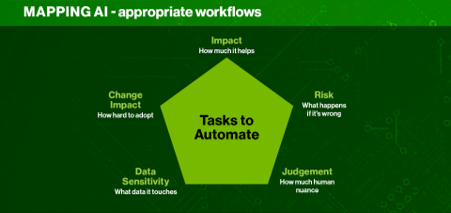
McKinsey’s State of AI report (November 2025) found that workflow redesign has one of the strongest correlations with achieving meaningful business impact from AI, yet only 20% of organisations using AI have fundamentally redesigned any workflows. High performers are 2.8 times more likely to have done this. The remaining 79% are layering AI onto existing processes and absorbing the cost without the return.5 This is what happens when tool deployment precedes strategic design. The tools work. The organisation is not ready for them. 3.2 Technical and data frictionsMost organisations do not have their knowledge in a form that AI can reliably use. Documents are duplicated, outdated, permission-bound, stored across cloud storage, email, messaging apps, and dependent on the institutional memory of experienced staff. An AI system cannot reliably retrieve and synthesise knowledge that has not been structured for retrieval — and the 8,700 staff whose departures are planned will inevitably include many of the people who currently hold that knowledge. The 2025 cross-agency survey confirms where AI is working well: assisted search, literature review, workflow automation, summarisation, and document support. These are real gains. They are also primarily bounded, transactional tasks. The more complex case management, policy analysis, and stakeholder engagement work that makes up the majority of public service delivery is a different category of challenge that requires contextual judgement, relational capacity, and institutional knowledge that current AI cannot substitute reliably. Data sovereignty adds a layer of constraint specific to the New Zealand public sector. Privacy Act 2020 obligations, Official Information Act expectations, and Māori data sovereignty principles limit which data can be processed by externally hosted AI systems. Microsoft Copilot, the AI tool most commonly deployed across government agencies, routes data through offshore servers by default. Without deliberate procurement decisions, Māori data sovereignty cannot be guaranteed at the tool level. This is a governance and procurement challenge, not simply a technical one. 3.3 Human and organisational frictionsDeploying AI tools changes what individuals can do at their desks. It does not change how work runs across teams. These are different problems requiring different interventions. McKinsey’s workflow redesign finding captures this precisely. Buying access to a capable model and running a training programme is not the same as redesigning the workflows that determine how projects are scoped, staffed, delivered, and reviewed. Without that redesign, efficiency gains are absorbed quietly into adjacent tasks rather than flowing through to service improvement or cost reduction. Only 20% of AI-using organisations have made that investment. At Allen + Clarke we use a structured approach to close the value gap: first map the tasks AI is actually suited to, then redesign the workflows around them, then expand use as confidence builds. The mapping step balances five competing pressures: the Impact a task offers, the Risk if AI gets it wrong, the Judgement the task requires, the Data Sensitivity involved, and the Change Impact on the people doing the work. Skipping the mapping is how organisations end up in the 79% of those who have implemented AI without seeing a return. ![]() Figure 2: Mapping AI - appropriate workflows Source: Allen and Clarke, AI Risk Management: How to Avoid Things Going Wrong
Another friction worth calling out: AI shifts the supervisory burden, creating a bottleneck at the senior review stage. A capable user can produce more first-draft material faster using AI. A polished but wrong answer is harder to catch than a rough but wrong answer, and senior reviewers are typically the staff most likely to be retained during a downsizing, while junior and mid-level ranks are reduced. The risk is a system producing more output with less capacity to catch errors in it. New Zealand public sentiment towards AI is a further constraint. Survey data consistently shows New Zealand and Australian attitudes towards AI to be more sceptical than equivalent populations in North America or Europe. This is especially true where AI is perceived to threaten jobs or distribute benefits unevenly. The political consequences of service failures attributed to AI would fall directly on the leaders and ministers. 3.4 Institutional and regulatory frictionsBetter AI models do not resolve institutional accountability questions. Someone still has to be responsible when a decision goes wrong, regardless of whether AI was involved. OECD AI governance frameworks are explicit: accountability for AI-assisted decisions sits with the human or institution, not the tool. In an organisation that has reduced its workforce by 14%, the practical question is: who is that person, and do they have the capacity, context, and authority to make those calls? Te Tiriti o Waitangi obligations add a structural constraint specific to New Zealand that will not diminish as AI capability improves. Engagement formats requiring a human counterpart — such as hui, consent processes, and sensitive community engagement — have features AI cannot replicate. The Treaty’s obligations around Māori data sovereignty, genuine participation, and Crown accountability are not technical problems awaiting a technical solution. They are political and relational ones that require human presence and accountability. |
|
New Zealand is not attempting something novel. The United Kingdom has been pursuing public sector AI transformation for longer and offers a useful point of comparison. The UK National Audit Office’s March 2024 report on AI use in government raised concerns about gaps in post-implementation evaluation across departmental AI deployments, removing the feedback loop that would allow departments to distinguish what works from what appears to work.6 Of the 87 UK government bodies surveyed, only 37% had actually deployed AI, with typically one or two use cases each. Over two-thirds were still piloting or planning. As of early 2026, analysis by Think Digital Partners found that UK public-sector AI initiatives remain largely stuck in pilot mode, stalling because of failures in procurement, governance, and delivery design — not because of capability shortfalls in the tools themselves.7 Victoria University of Wellington Senior Lecturer in Artificial Intelligence Dr Andrew Lensen, winner of the 2026 Critic and Conscience of Society Award, said in direct response to the Budget announcement that there was “no way AI could replace thousands of public servants” in its current form, and that it was “naive of the government to see it as a silver bullet.” His specific assessment: “If we want to use AI in the public sector, then we have to do some really good investigations into how to use it and do some good testing. We can’t simply drop it in and hope it solves our issues.”8 A New Zealand Parliamentary Select Committee report released in May 2026 noted that firms in markets further along the AI adoption curve, including in Australia, the UK, and the US, are not yet seeing a return on AI investment at scale.9 The NZ government’s own cross-agency survey data makes the same point from the inside. 272 use cases across 70 agencies with 55 operational: this is a public sector at the beginning of AI deployment, not one ready to absorb large workforce reductions through AI substitution within a three-year budget cycle. |
|
Government services are changing, and building a more efficient public service is a legitimate goal. The concern here is sequence: the foundation has to be in place before the workforce that currently carries institutional knowledge is reduced. Organisations that successfully deploy AI at scale do it in a specific order: 5.1 Strategy and governance firstDefine what the organisation is trying to achieve with AI. Set an explicit risk appetite. Consciously make the ownership decision — IT or operational leadership — with full awareness of its downstream effects on culture and pace. Establish policy boundaries: what data AI can touch, who reviews outputs, what the escalation paths are, and who bears accountability when things go wrong. 5.2 Data and knowledge readiness secondBefore deployment can succeed at scale, the institutional knowledge AI needs to work reliably must be structured, maintained, and made accessible. What data can AI access, how, and what safeguards are needed to be in place before access is granted. For New Zealand government agencies, this includes a deliberate conversation about Māori data sovereignty, what responsible stewardship of those data relationships requires, and what it rules out. 5.3 Workflow redesign thirdNot “add AI to existing processes”, but genuine redesign by organisations of how projects are scoped, delivered, reviewed, and evaluated. McKinsey’s data is clear: this is where the returns are, and it is where 79% of organisations are currently failing to invest. If Ministers / the public sector wants to achieve widespread uptake there are some things that can be ‘baked in’ to ensure use is easy, follows standardised processes designed to deliver efficiency, and can be adapted easily for the next stage of uptake, and that have the guardrails built in, so people can use the tools confident that they are doing the right thing. 5.4 Capability building alongside, not afterAI fluency is uneven in every organisation. Building the skill to use AI well and to know when not to use it is a continuous process, not a one-time training event. This is especially true during transitions where experienced staff are leaving and institutional knowledge is at risk of being lost. If we want widespread uptake, we need to encourage staff to experiment, and learn ‘on the job’ whilst being supported by AI experts, rather than think that capability building is about training courses. After all, when was the last time a training course alone completely changed the way you worked? 5.5 Measured deployment with evaluation built in from day oneThe UK’s post-implementation evaluation gap is a warning. Without feedback loops, it is impossible to distinguish what is working from what appears to work. The standard set by the UK National Audit Office, where fewer than half of deployments were evaluated, is not one New Zealand should replicate. |
|
Allen + Clarke works alongside governments, private sector organisations, and NGOs that are navigating this challenge. We help leaders build the strategic and governance foundation that determines whether AI creates value or creates new problems, the organisational readiness work, the change management, the Te Tiriti-informed data frameworks, and the measurement discipline that makes AI investment actually pay off. The risk that leaders responsible for Budget 2026 implementation now own is not that AI can’t help. It is that moving at budget speed without the strategic foundation creates the delivery failures and reputational damage they are working to avoid. To talk through what this means for you, contact us at [email protected]
Sources 1 Jo Moir, RNZ, 'Nearly 9000 public sector jobs to go, government agencies to merge, Nicola Willis announces', 19 May 2026. rnz.co.nz 2 Anthropic, Labor Market Impacts of AI: A New Measure and Early Evidence, 5 March 2026. anthropic.com 3 Ivan Yotzov, Jose Maria Barrero et al., Firm Data on AI, NBER Working Paper 34836, 2026. nber.org/papers/w34836 4 New Zealand Government, 2025 Cross-Agency Survey for Artificial Intelligence (AI) Use Cases. digital.govt.nz 5 McKinsey & Company, The State of AI: Agents, Innovation, and Transformation, November 2025. mckinsey.com 6 National Audit Office, Use of Artificial Intelligence in UK Government, March 2024. nao.org.uk 7 Think Digital Partners, ‘Why UK government AI projects stall – and what public sector leaders need to do next’, 29 April 2026. thinkdigitalpartners.com 8 Dr Andrew Lensen, Victoria University of Wellington. “Is AI the answer to a leaner public service?” RNZ Checkpoint, 19 May 2026. rnz.co.nz/national/programmes/checkpoint/audio/2019035728/is-ai-the-answer-to-a-leaner-public-service 9 Newsroom, ‘NZ firms warned overseas businesses aren’t getting a return on AI – MPs’ report’, 5 May 2026. newsroom.co.nz
|